Patch basics
Sew-on, iron-on or hook-and-loop: choosing a patch backing
Compare sew-on, iron-on and removable patch backings, including garment compatibility and attachment questions.
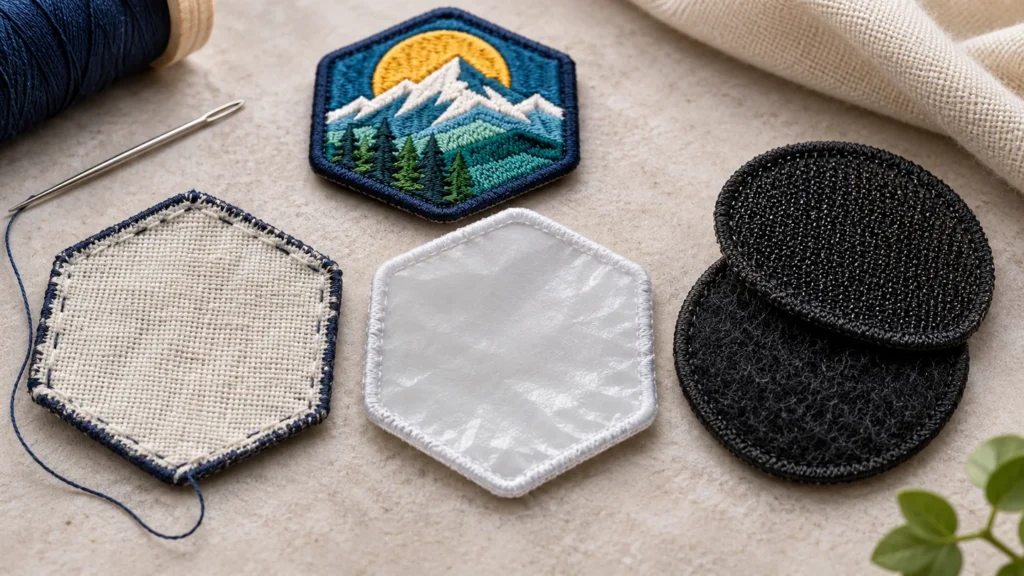
Patch backing should be chosen around the garment and the way the patch will be used. A removable team identifier, a permanent uniform badge and a decorative patch for an event have different attachment requirements even when their artwork is identical.
Compare the main options
| Backing or attachment | Useful when | Check before ordering |
|---|---|---|
| Sew-on | A permanent attachment is wanted and stitching is suitable | Access to the reverse, fabric strength and seam position |
| Heat-seal / iron-on | The patch and garment are approved for heat application | Supplier-specific temperature, time, pressure and cooling instructions |
| Hook-and-loop | The badge will be removed, exchanged or transferred | Matching receiving loop, orientation and attachment of both parts |
| Pressure-sensitive adhesive | A compatible temporary or hard-surface application is intended | Surface suitability, residue, wear limits and whether it is washable |
Backing names are sometimes used loosely. Ask for a sample or a photograph of the reverse so you know what will actually arrive.
Sew-on: consider the whole garment
Sewing can provide a dependable attachment when done correctly, but the person applying the patch still needs access. Stitching a badge onto a pocket may close the pocket if the layers are not separated. Lined jackets may need a different approach from an unlined cotton bag.
Do not modify protective clothing or equipment without the appropriate approval. A strong seam is not proof that the finished item still meets its original performance requirements.
Heat-seal: compatibility comes first
Heat application depends on the adhesive, patch thickness, garment and equipment together. There is no safe universal setting for every product sold as an iron-on patch. Some coatings, synthetics and delicate materials can be damaged or may not bond reliably.
Ask for written instructions for the exact patch. Test a spare garment or an inconspicuous area as appropriate, and confirm whether a household iron is supported. A heat press provides controlled pressure more consistently, but it still needs the correct settings and loading method.
The application guide explains how to plan a test without guessing.
Hook-and-loop: specify both sides
Confirm whether the order includes the hook-backed patch only or the matching loop piece as well. Record which side is already on the garment, the finished shape and whether the loop piece needs sewing or another approved attachment.
Check orientation before application. A long name strip that fits the receiving area horizontally may not fit a vertical sleeve position. Also consider whether exposed hooks could snag nearby garments when the patch is removed.
Adhesive is not automatically permanent
Pressure-sensitive backing can be convenient, but it should not be treated as a substitute for a washable garment attachment unless the manufacturer explicitly supports that use. Rough, oily, coated or flexible surfaces may behave differently from a clean, smooth sample board.
If you are planning patch stickers, define the destination surface and expected lifespan first. Test removal as well as adhesion, particularly on a valuable item.
Build the backing into your order brief
Describe the receiving material, whether the patch must be removable, the cleaning method and who will attach it. For a uniform order, include the exact garment model if possible. For a product launch, add attachment labor and testing to the budget.
Example: a staff name badge may need hook-and-loop for employee changes, while the company emblem on the same shirt is sewn permanently. Using one backing for both just because they share a purchase order can create avoidable problems.
Before approving production, make sure the backing appears in the written order confirmation—not only in a message sent early in the discussion.
Have a patch or artwork project in mind? Talk with Embroidery Job.