Materials
Leather patches for hats, jackets and small collections
Prepare leather patch artwork with suitable contrast, edge treatment, cap fit and material-specific care.
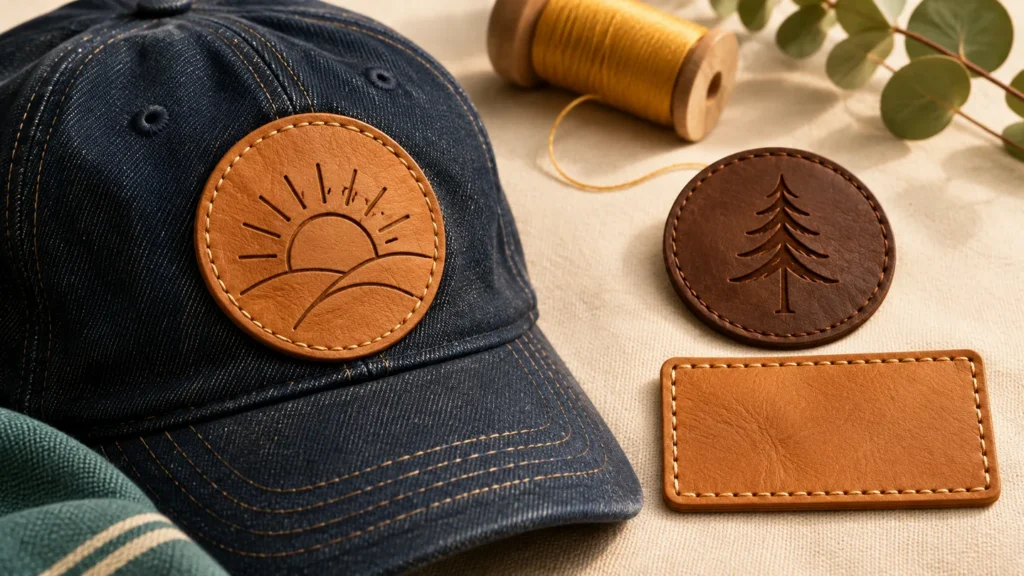
Leather patches give a logo a different character from bright thread or molded rubber. Engraved lines, surface grain and a restrained color palette can work well on hats, denim and small accessories. A successful design accounts for the material's contrast, flexibility and care requirements from the beginning.
Confirm what material is being quoted
Genuine leather and synthetic leather alternatives are not interchangeable specifications. Ask for the material description, thickness, surface finish and available colors. If composition matters to your customers, obtain a clear supplier statement before labeling the finished product.
Natural leather can show variations in grain and tone. Decide whether those variations are part of the appeal or a concern for a tightly matched collection. A sample establishes a better expectation than a single carefully lit product image.
Design for engraved contrast
Start with a strong silhouette and lines that have room to remain distinct. Dense illustrations and closely packed small text can become visually muddy when rendered as an engraved design. Contrast depends on the material and process, so do not assume every tan, brown or black stock will produce the same result.
For a small cap badge, a recognizable emblem with a short name often works better than an emblem, slogan, address and date together. Preserve the full logo for a larger placement and approve a compact version for the patch.
Choose the edge deliberately
| Edge treatment | What to review |
|---|---|
| Plain cut perimeter | Shape accuracy, corner finish and distance from artwork |
| Engraved stitch effect | Whether the decorative line is clearly specified as engraving |
| Actual stitched border | Thread color, stitch path and space from the edge |
An engraved stitch pattern is a visual detail; it is not the same as sewing the patch to a garment. If the patch will be attached later, specify the actual attachment process separately.
Check the fit on the item
A patch that looks balanced on a flat sheet may feel too large on a curved cap. Test the width, height and stiffness against the exact cap model. Avoid placing important artwork over a strong bend or forcing a thick patch across an awkward seam.
For bags and jackets, consider linings and access for stitching. If replacing an old badge, check whether its former stitch holes or marks will remain visible outside the new outline. See our size and placement guide before finalizing dimensions.
Treat care as a buying decision
If the item will be washed frequently, ask whether the proposed leather construction and attachment suit that routine. Leather may change appearance with moisture, abrasion and cleaning; a label such as “premium” does not tell you how it will behave.
Request specific care guidance and test a sample on the actual item. Do not apply a generic iron-on temperature to leather, or assume a backing makes a material suitable for machine washing. Keep the care instructions with the finished product information.
Approve a repeatable specification
Save the artwork version, dimensions, material code, color, thickness, edge and attachment details. For a repeat order, identify which differences are acceptable and which require review. If natural variation is expected, communicate that honestly in your product photography and description.
Leather is a strong option when the design benefits from a simple engraved identity. For vivid full-color artwork or photographic detail, compare PVC, embroidery and printed patches before committing to a material that changes the design's character.
Have a patch or artwork project in mind? Talk with Embroidery Job.