Teams & events
Aviation and automotive patches: turning a shared passion into an emblem
Turn aviation and automotive interests into original patch emblems with readable details and a practical event brief.
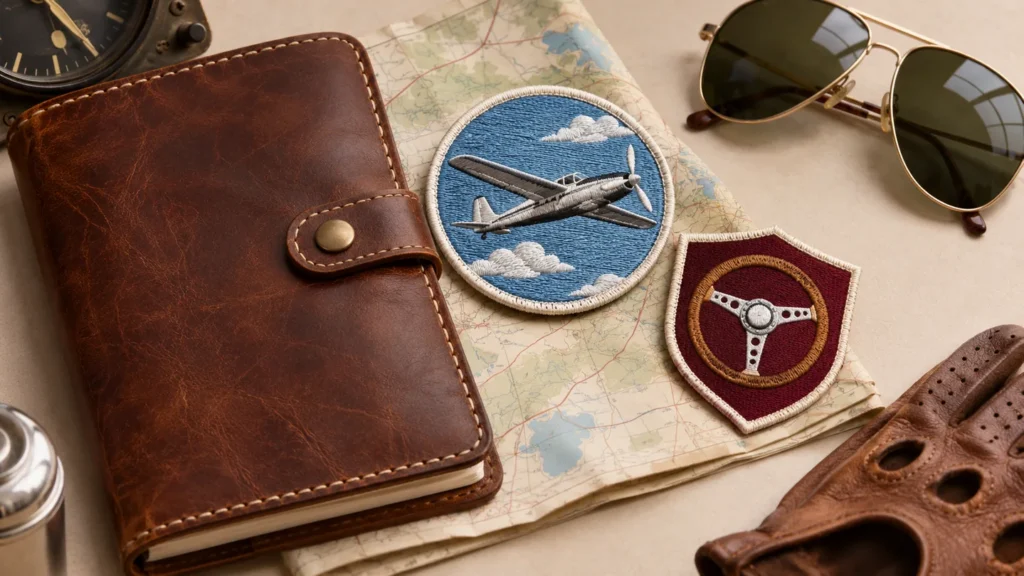
Aviation and automotive patches often begin with a shared enthusiasm: a flight club, a restoration project, a road trip or a show. A strong emblem captures that connection without trying to fit an entire aircraft, vehicle history and event program into a small badge.
Find the most recognizable element
Choose the feature that carries the story. It might be an original silhouette, a route line, a mechanical detail or a simple symbol connected to the group. Use the event or club name as supporting information rather than letting several messages compete equally.
If you are depicting a particular aircraft or vehicle, decide how much technical accuracy is necessary. A stylized emblem can simplify small details, but important proportions should remain recognizable. Ask an organizer or knowledgeable reviewer to check the drawing before it becomes a production proof.
Keep permissions clear
Manufacturer logos, airline identities, racing-team marks and official event graphics may have usage restrictions. Obtain the relevant permission before reproducing them on merchandise. An original illustration of a theme is different from copying a protected emblem.
For a club or show, confirm the approved name and whether the patch is an official event item or an independently created design. Make that distinction clear in packaging and promotion so buyers understand what they are receiving.
Match the format to the use
| Project | Practical design direction |
|---|---|
| Club jacket badge | Strong identity with readable name |
| Show souvenir | Event name and clearly checked date |
| Route or flight milestone | A simple route symbol and meaningful location |
| Collector series | Related shapes or palette with distinct subjects |
| Tool bag or travel bag | Bold emblem with an attachment suited to the surface |
Detailed mechanical drawings may need a larger format, a woven interpretation or a printed construction. Embroidery works well when lines and shapes have enough space. Compare the actual-size result rather than selecting a material from an enlarged mockup.
Use dates and numbers carefully
Registration identifiers, model years and event numbers can be central to the design. Check them against a written source supplied by the organizer. Keep private or sensitive identifiers out of public merchandise unless the owner has agreed to their use.
If the design will return annually, create a controlled template for the changing year or event edition. Review the updated proof as a new order instead of assuming only one field has changed correctly.
Plan the sample and delivery
Ask for the patch on the intended garment or a realistic placement mockup with dimensions. For flight jackets, workwear or specialist garments, follow the owner's decoration requirements and do not imply that an ordinary patch has protective or operational certification.
For a show, include time for packaging and distribution in the deadline. Confirm quantities, setup costs, backing and whether the order is delivered loose or applied. Our ordering guide gives a complete checklist.
Give the design a story beyond the badge
A short card can explain the route, project or occasion without squeezing extra text into the artwork. Keep the story factual and distinguish a fictional concept from a documented historical event. That makes the patch more meaningful while leaving the design clean enough to recognize at a glance.
Have a patch or artwork project in mind? Talk with Embroidery Job.