Teams & events
Law enforcement patches: identity, approvals and wear requirements
Organize law enforcement patch artwork, approvals, uniform requirements and repeat orders in one clear brief.
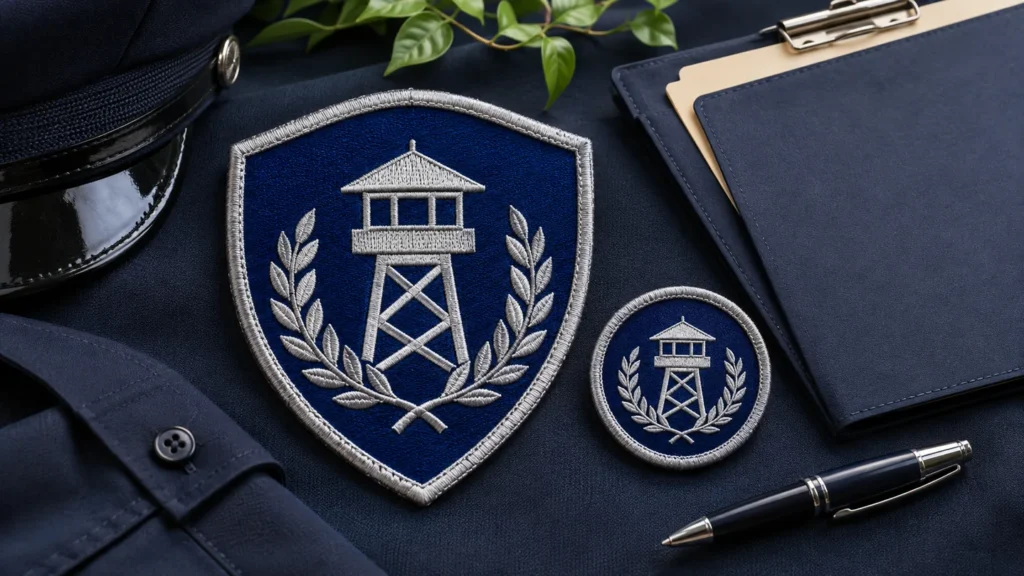
A law enforcement patch can communicate an agency identity, unit, role or commemorative purpose. Accuracy and authorization matter as much as visual quality. Begin with the agency's current requirements and an approved artwork source before choosing materials or ordering samples.
Define the intended use
Operational uniform identification, training merchandise, a retirement gift and a collector's item are different projects. Confirm who is authorizing the design and whether the patch may be distributed beyond the intended organization. A supplier should not have to infer those decisions from a badge image alone.
For public-facing uniforms, ask the responsible agency to confirm wording, symbols, colors, shape and placement. Avoid treating another agency's patch as a template that can be reproduced with a small name change. Build the brief around the identity you are authorized to use.
Check the artwork before the material
Use a current original file where available. Compare all wording with the approved agency name and unit designation. Pay attention to abbreviations, state or regional references, dates and small numbers. These are easy to miss when reviewers concentrate only on the central emblem.
A detailed seal may need a larger patch or a carefully approved simplified version. Ask for proposed changes explicitly. Do not allow small details to disappear unnoticed in a production translation. The proof checklist provides a useful review order.
Match construction to the uniform requirements
| Requirement to discuss | Why it changes the order |
|---|---|
| Permanent or removable identification | Determines attachment and receiving-panel needs |
| Garment model and location | Controls usable size and sewing access |
| Routine cleaning | Affects the acceptable material and assembly |
| Visibility expectations | Requires an approved color and material specification |
| Repeat-order consistency | Calls for retained artwork and sample references |
Do not assume a subdued color scheme, reflective element or particular material meets an agency requirement without confirmation. A decorative product description is not a compliance specification. Obtain any required performance documentation through the appropriate uniform purchasing process.
Review the sample in context
Inspect the sample on the actual garment or receiving panel. Check orientation, alignment, edge clearance and the readability of the primary name. A badge that looks balanced alone can sit awkwardly beside an existing name strip or equipment attachment.
For removable patches, confirm both sides of the attachment system and the required dimensions. For sewn patches, agree on the stitch path and whether installation is included in the quote. Different uniform styles may need separate placement instructions.
Keep repeat orders controlled
Store the approved file, proof, construction specification and order reference together. Identify the person who can authorize reorders or changes. If an agency or unit identity is updated, retire the previous ordering file so obsolete artwork is not accidentally reused.
For commemorative pieces, make the occasion clear and use the organization's approved distribution rules. Avoid suggesting that possession of a patch establishes official status. The patch is a designed object; authority and eligibility come from the organization.
Once those decisions are confirmed, use our ordering guide to prepare a complete request with quantity, dimensions, attachment, sample needs and the required delivery date.
Have a patch or artwork project in mind? Talk with Embroidery Job.