Merch planning
Designing a team or event scarf people will actually wear
Plan scarf artwork for both sides, readable lettering and real wearing positions before a manufacturer makes samples.
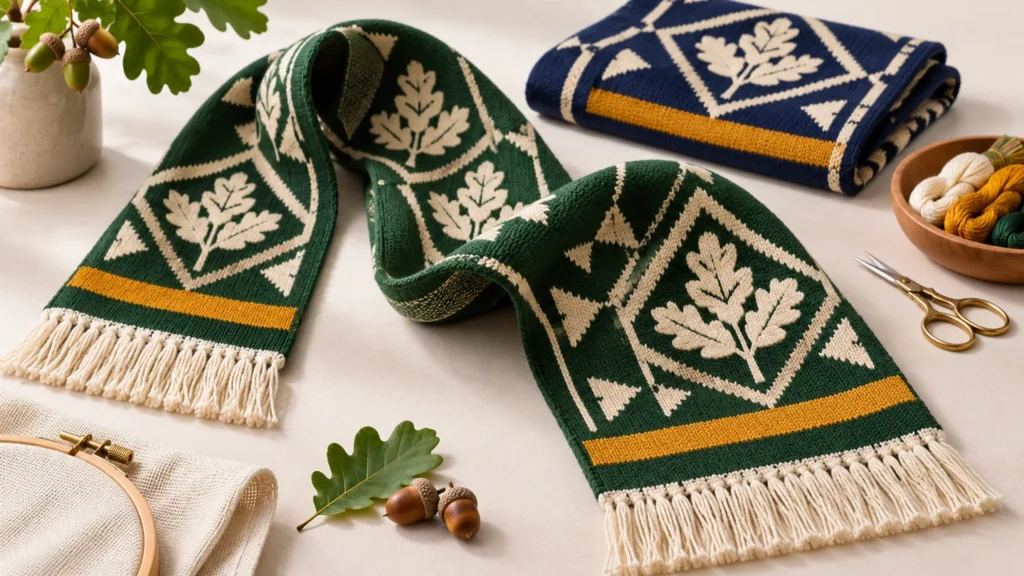
A custom scarf has two jobs: carry the design clearly and remain something people want to wear. Its long format can show a team name or event message well, but folds and two-sided construction change how that message appears. This guide helps you prepare artwork for a scarf manufacturer; it does not advertise scarf manufacturing by Embroidery Job.
Choose the scarf format first
Ask the manufacturer for dimensions, construction options and an artwork template. Knitted, woven and printed scarves have different surfaces and design constraints. A soft fashion scarf and a bold supporter scarf are not the same production brief.
Confirm whether the design appears on one side, both sides or as separate front and back layouts. Ask how the ends, fringe and edge areas are treated. Do not place important lettering outside the usable area shown in the actual template.
Design for wearing and holding
Review the scarf flat, draped around the neck and held horizontally. A phrase that reads well in a product photograph may be hidden when worn. Put key symbols where they remain useful across those positions.
For two-sided designs, check text direction and orientation explicitly. Avoid assuming the reverse will automatically match the front in the way you expect. Mark the intended view on the proof so the manufacturer and reviewer are discussing the same side.
Build a clear visual hierarchy
| Element | Practical role |
|---|---|
| Main name or phrase | The message seen from a distance |
| End symbols | Identity visible when the scarf is worn |
| Supporting pattern | Connects the design without competing with the text |
| Color blocks | Give structure to the long format |
| Fringe or edge | Completes the palette and construction |
Use lettering with enough space between characters. Intricate scripts, thin outlines and long sponsor lists can become hard to reproduce or read. If the process has a restricted color palette, adapt the artwork deliberately instead of letting an automatic conversion make the decisions.
Confirm permission for team and event marks
Use approved logos and names. Professional sports identities, event graphics and sponsor marks may need authorization for merchandise. An original club or community design should be reviewed by the person responsible for the organization's identity.
For a commemorative scarf, check dates, location names and edition wording against a written master. If future editions are planned, keep the template and clearly identify the changing elements.
Evaluate the physical sample
Check the artwork, color relationships, feel, dimensions and finishing. Ask for the material composition and care instructions. Judge the sample in the way it will be used rather than only laid flat under studio lights.
For event distribution, include time for sample review, production, shipping and packing. Confirm the actual schedule with the manufacturer after the design and quantity are settled. A general fast-delivery claim is not a substitute for an order-specific plan.
Keep the artwork handoff complete
Supply editable artwork where available, the correct template, color references and marked front/back previews. Our print-ready file guide can help prepare logos for that handoff. If scarves are one part of a larger merchandise range, use the brand consistency guide to connect the products while respecting each manufacturing process.
Have a patch or artwork project in mind? Talk with Embroidery Job.