Materials
When fine detail calls for a woven patch
Learn when woven construction may suit fine textile detail and what to check in the artwork, edge and sample.
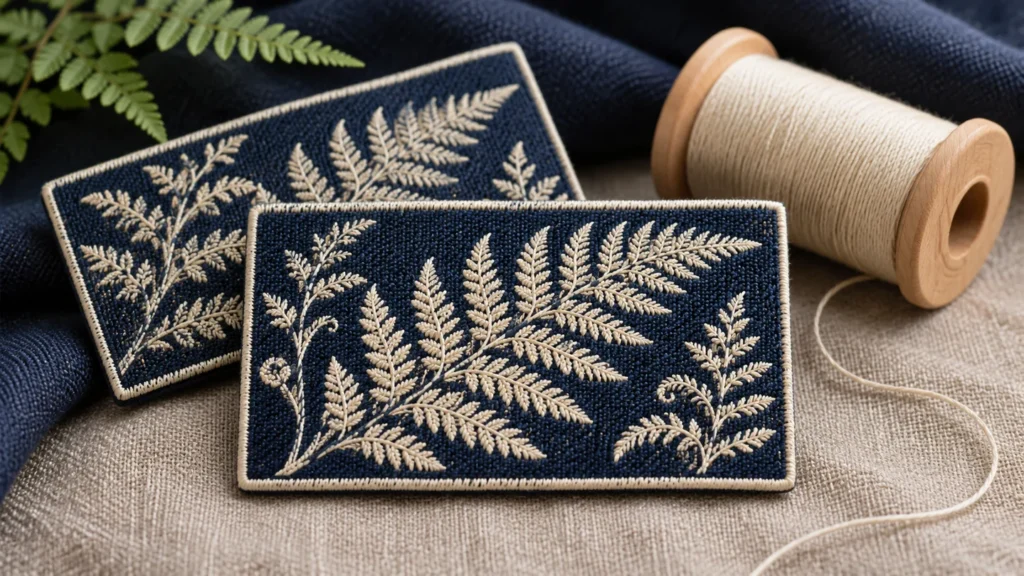
Woven patches are worth considering when the important part of a design is its fine lettering or compact detail. Their flatter textile surface gives a different look from the more pronounced stitches of embroidery. The right choice depends on what must remain recognizable at the finished size.
What changes when a patch is woven?
In a woven patch, the design is formed through the weaving process. In an embroidered patch, stitching is added to a base. Both use thread, but their surfaces and detail handling differ. Woven artwork often looks flatter and smoother; embroidery puts more emphasis on visible stitch texture.
That difference does not make one universally better. A large varsity-style emblem may benefit from texture, while a small label with several lines of text may benefit from a finer construction. Ask to compare samples at the intended size rather than enlarged product photographs.
Use this design checklist
- Identify the smallest text that genuinely needs to stay.
- Remove ornamental lines that do not contribute to recognition.
- Separate neighboring colors with enough contrast.
- Leave space between the design and the finished edge.
- Provide the complete outline, including any unusual corners.
Fine detail still has limits. A woven patch cannot guarantee readable text just because the artwork file is sharp. Thread, construction, contrast and finished dimensions all affect the result. Request a production review before treating a digital proof as a promise of exact reproduction.
Woven, embroidered or printed?
| Your priority | A useful first comparison |
|---|---|
| Small lettering and a textile finish | Woven versus simplified embroidery |
| Visible raised stitch character | Embroidery versus woven |
| Photographs or continuous gradients | Printed patch versus woven interpretation |
| A bold, dimensional rubber effect | PVC rather than a textile construction |
For mixed artwork, decide which quality matters most. A club badge with a fine motto may need a larger size or shorter wording even if you choose woven. A photo-based design may lose some tonal detail when translated into thread colors.
Edge and attachment still need decisions
The face material is only one part of the specification. Confirm the finished border, backing and overall thickness. A thick edge can take up valuable room on a small badge. An adhesive choice must suit both the patch construction and the garment it will be attached to.
Ask whether quoted dimensions include the border. If the patch is replacing an existing badge, measure the old badge and the available garment space. Do not assume the new design will cover old stitch holes or adhesive marks without checking.
Approve a useful sample
Examine letter openings, narrow color separations and the alignment of the woven face with its edge. Place the sample on the intended garment and compare it at normal viewing distance. Where exact color matters, agree on a physical reference and a realistic matching process.
Keep a written record of the approved dimensions, colors, edge and backing for future orders. If you change the size later, request a new review: tiny lettering that works in one size may need adjustment in another.
Is woven the answer to every detailed logo?
No. Some logos need simplification, more space or a printed construction. Woven is one useful option in that discussion. Read our material comparison and design checklist before choosing a production route; those decisions can save more time than trying to repair an unsuitable design after sampling.
Have a patch or artwork project in mind? Talk with Embroidery Job.